This is the concise English guide. The Turkish edition includes the extended itinerary and planning notes.
Historic names and a place of crossing
The municipality’s historical account connects Üsküdar with names such as Khrisopolis and Skutarium, while noting differing views about the name’s origin. Avoid treating one naming story as a definitive explanation. Its position on the Bosphorus helps explain the area’s importance for movement and settlement across different periods.
Look beyond the mosque alone
During the Ottoman period, fountains, schools, baths and other public buildings helped shape Üsküdar alongside its mosques. At a historic complex, the courtyard, street and relationship between buildings can reveal more than a photograph of one façade.
Two stops, two different scales
Look at Mihrimah Sultan Mosque in relation to the square, and Şemsi Pasha Mosque in relation to the shore. Both are associated with Mimar Sinan, but they offer different spatial experiences: the movement of the square at one and a closer connection with the water at the other.
What to notice on a history walk
Look at stone and timber surfaces, thresholds, inscriptions and street gradients. Rather than guessing the meaning of an inscription, photograph it where permitted and consult a reliable source. Remember that historic buildings undergo repair and restoration; an old-looking surface is not necessarily original.
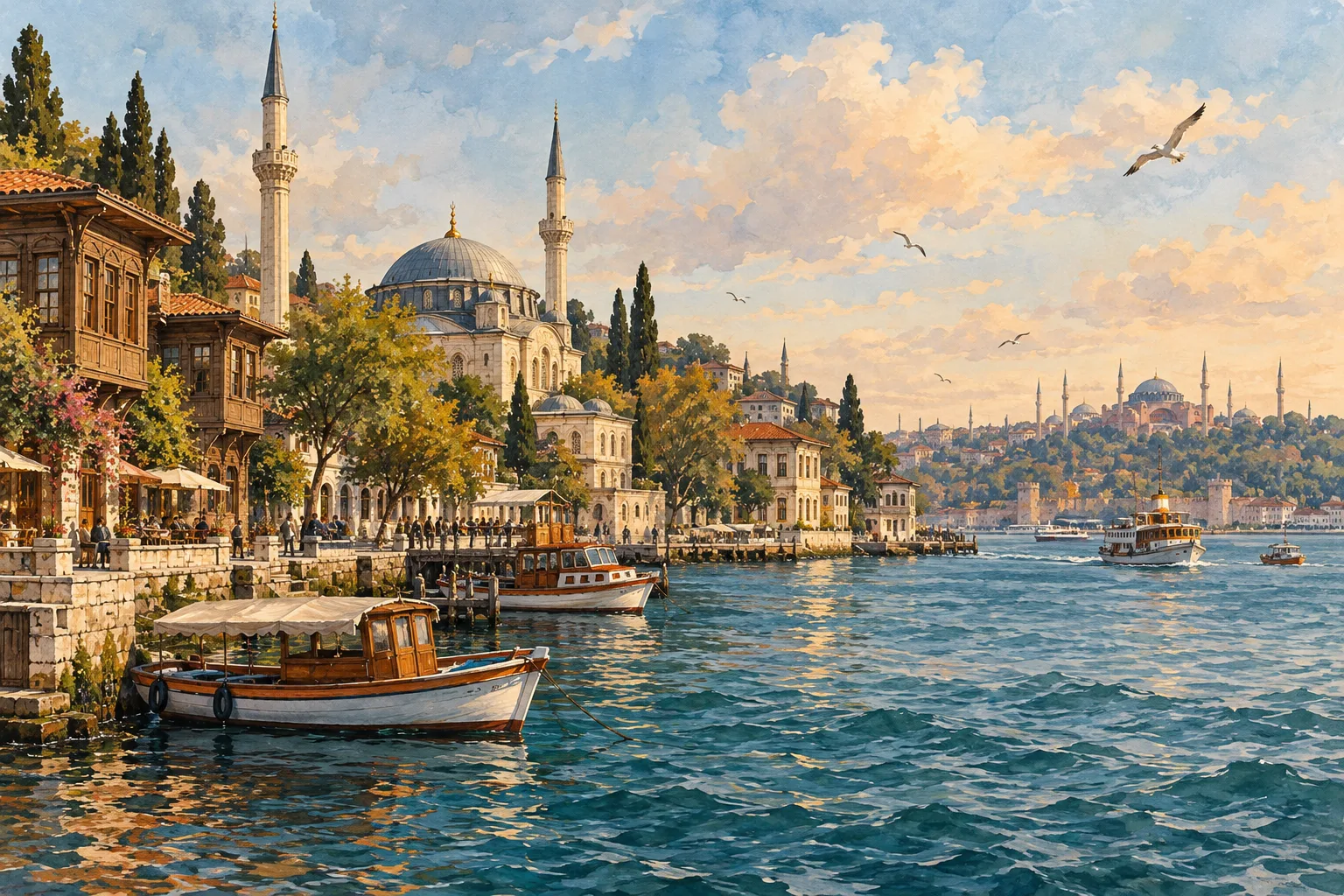
The cover is an illustration interpreting a historical atmosphere, not an archive photograph or an exact reconstruction of a particular period. Use the municipal sources below as a starting point for a more documented exploration.